
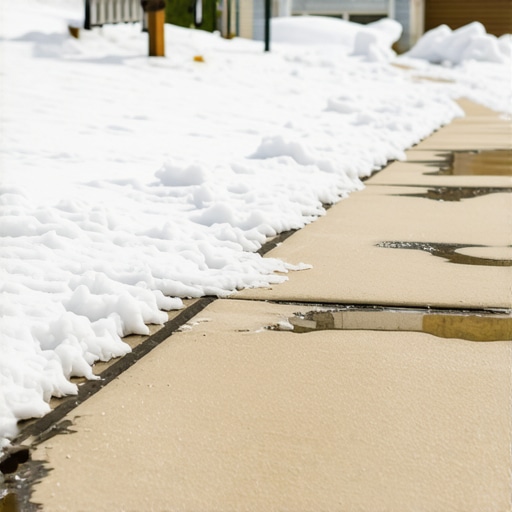
The Specific Concrete Sealer That Actually Protects McCordsville Driveways from Winter Salt
If you live in McCordsville or near the Geist Reservoir, you know the drill. Every spring, as the snow melts and the gray slush retreats, a depressing sight emerges on your driveway: white, chalky stains, small pits, and “spalling” – those thin flakes of concrete that peel away like a bad sunburn. You might have tried the five-gallon buckets of sealer from the local hardware store, spending a weekend rolling it on, only to see the same damage return twelve months later. The truth is, Central Indiana’s climate is a graveyard for standard concrete sealers.
The “silent killer” of Indiana concrete isn’t just the cold; it is the combination of the relentless freeze-thaw cycle and the aggressive road salts used by McCordsville and Geist municipal crews. To truly protect your investment, you need more than a hardware-store acrylic. You need a professional-grade solution that understands the chemistry of concrete and the physics of ice. In this guide, we will explore the specific polyaspartic garage floor coating and polyurea floor coating technologies that actually stand up to the Hoosier winter.
Why Standard Concrete Sealers Fail in Central Indiana
Most homeowners believe that all concrete sealers are created equal. They typically fall into two categories: penetrating sealers and topical acrylic sealers. While these products might work in the mild climates of the South, they are woefully inadequate for McCordsville’s extreme temperature swings. Penetrating sealers often lack the density to block out the “brine” created by road salt, while topical acrylics are notorious for “delaminating” or peeling off when subjected to the heat of your car’s tires.
The primary reason these sealers fail is their lack of breathability and poor adhesion. Acrylic sealers create a thin film that sits on top of the concrete. When moisture gets trapped beneath that film and then freezes, it pushes the sealer off the surface. Furthermore, these DIY products cannot withstand “hot tire pick-up,” where the heat from your tires softens the sealer, causing it to peel away as you pull out of the garage. If you aren’t sure if your current sealer is still working, you can use the spray-bottle hack for testing floor sealer coverage to see if your concrete is actually protected or if it’s drinking in moisture like a sponge.
In the Geist area, where road treatments are heavy to keep the winding lakeside roads safe, these standard sealers are chemically outmatched. They are simply too brittle and too thin to act as a true barrier against the chemical intensity of modern de-icing agents.
The Science of the “Salt Attack” on McCordsville Driveways
To understand why you need a high-performance concrete sealer, you have to understand what is happening inside your driveway at a microscopic level. Concrete is a porous material; think of it as a very hard, very dense sponge. In Central Indiana, we experience an average of 40 to 60 freeze-thaw cycles every single year. This is the most destructive force your concrete will ever face.
When water enters the pores of your concrete and freezes, it expands by approximately 9% in volume. This expansion creates immense internal pressure. Over time, this pressure exceeds the strength of the concrete, leading to “spalling” or flaking. Now, add road salt (Sodium Chloride or Calcium Chloride) to the mix. Salt is “hygroscopic,” meaning it naturally attracts and holds more moisture. When salt sits on your driveway, it creates a brine that lowers the freezing point of water. This sounds like a good thing, but it actually increases the frequency of the freeze-thaw cycles, as the water melts and refreezes more often than it would naturally.
This salt brine doesn’t just sit on top; it eats into the alkaline structure of the concrete, weakening the bonds that hold the aggregate together. This leads to deep pitting and structural degradation. If you already have damage, you must address it before applying any high-end coating. You can learn how to repair a cracked concrete slab before tiling or coating to ensure the foundation is sound before the winter hits again.
Polyaspartic vs. Polyurea Floor Coating: The Professional Standard
When we talk about the “specific sealer” that actually works, we are talking about polyaspartic garage floor coating and polyurea floor coating. These are not your average paints or epoxies. They are advanced polymers designed for industrial environments, now adapted for residential use in McCordsville garages and driveways.
What is Polyurea? Polyurea is a subgroup of polyurethane. It is known for its incredible “elongation rate.” In the world of concrete coatings, elongation is everything. High-quality polyurea can have an elongation rate of up to 300%. This means the coating can expand and contract along with the concrete as Indiana temperatures swing from -10°F in January to 95°F in July without cracking or losing its bond.
What is Polyaspartic? Polyaspartic is essentially a “slowed-down” version of polyurea. Originally developed to coat steel bridge trusses and spray-on truck bed liners, it is roughly four times more durable than standard epoxy resin flooring. Most importantly for McCordsville homeowners, polyaspartic is 100% UV stable. While epoxy will yellow and “chalk” when exposed to the sun on a driveway or near a garage door opening, polyaspartic remains crystal clear and vibrant for decades.
Why not just use epoxy? While a metallic epoxy floor looks stunning in a climate-controlled basement, it is often too brittle for the exterior or the garage floor in Indiana. Epoxy doesn’t “breathe” well and has a much lower elongation rate. This is why your garage epoxy is peeling under your tires – it simply can’t handle the thermal shock and the chemical assault of road salt like a polyaspartic system can.
Beyond the Driveway: Concrete Patio Coatings and Pool Decks
While the driveway and garage take the brunt of the salt damage, your outdoor living spaces are also at risk. For homes along the Geist Reservoir, concrete patio coatings and coating for concrete pool decks are essential for both aesthetics and safety.
A polyaspartic coating on a pool deck provides a non-slip texture that is much safer than bare, wet concrete or slick acrylic sealers. Because these coatings are UV stable, they won’t fade or peel under the intense summer sun. They also provide a seamless, waterproof barrier that prevents the same freeze-thaw damage from ruining your expensive patio or pool surround. For those looking for a more “designer” look inside the home, such as in a walk-out basement or a “man cave” overlooking the lake, a metallic epoxy floor offers a high-end, marble-like finish that is incredibly easy to clean and maintain.
Whether it’s a standard flake finish for the garage or a custom color for the patio, these garage flooring solutions provide a level of protection that simply cannot be replicated by DIY methods. They turn a porous, vulnerable slab into a fortified, easy-to-clean surface that adds genuine value to your McCordsville property.
The Importance of Professional Preparation
You can buy the most expensive polyurea floor coating in the world, but if the preparation is wrong, the coating will fail. This is where most DIY projects go south. Professional installers don’t just “wash” the floor; they use industrial diamond grinders to “open up” the pores of the concrete. This creates a “mechanical bond,” allowing the coating to anchor itself deep within the slab rather than just sitting on the surface.
Before any coating is applied, moisture testing is mandatory. In the Geist area, the high water table can lead to “capillary rise,” where moisture is pushed up through the concrete. If the moisture levels are too high, the coating won’t bond. Furthermore, any existing oil stains or previous sealers must be completely removed. This often involves the concrete etching step you shouldn’t skip before leveling or coating, ensuring the surface pH is balanced and the profile is rough enough for maximum adhesion.
Professional grade polyaspartic also has an extremely fast “set time.” It can dry in as little as 30 minutes, which is why it requires a trained two-to-three-person crew to apply it evenly. This fast cure time is a benefit to the homeowner – you can often drive on your new garage floor in just 24 hours – but it makes it nearly impossible for a solo DIYer to manage without leaving streaks or “lap lines.”
Maintenance Tips for Your New Coating
Once your high-performance concrete sealer or coating is installed, maintenance becomes a breeze, but it isn’t non-existent. The goal of a polyaspartic floor is to keep the salt and moisture out of the concrete. However, the salt can still sit on top of the coating. During the winter, it is a good practice to occasionally rinse your garage floor or driveway to remove the abrasive salt crystals and road grime.
When cleaning, avoid harsh acids or citrus-based cleaners. And most importantly, stop using vinegar on your hardwood floors immediately – and don’t use it on your professional concrete coatings either. While vinegar is a popular “natural” cleaner, its acidity can dull the finish of a high-gloss coating over time. Instead, use a pH-neutral cleaner or simply a mild dish soap and a squeegee. Because the surface is non-porous, dirt and salt have nowhere to hide, making your spring cleaning a five-minute task instead of a weekend-long chore.
Conclusion & Call to Action
McCordsville winters are inevitable, and the road salt isn’t going anywhere. But the “spalling,” pitting, and cracking of your concrete don’t have to be part of the season. By moving away from temporary, hardware-store acrylics and investing in industrial-strength polyaspartic garage floor coating or polyurea floor coating, you are choosing a solution that is engineered for the Indiana climate.
Your driveway and garage are the first things people see when they pull up to your home. Don’t let the “salt attack” ruin your curb appeal and devalue your property. Protect your concrete with a system that is 4x stronger than epoxy and 100% UV stable.
Ready to give your McCordsville home the protection it deserves? Visit our Contact Us page today for a free, no-obligation estimate on your next concrete coating project. Let’s make sure this winter is the last one that leaves a mark on your driveway.